Blue Cross LovePet Outpatient Insurance review: useful but deliberately narrow
A Hong Kong review of Blue Cross LovePet Outpatient Insurance, including its HK$3,000/HK$4,500 limits, 20% co-insurance, waiting period and claim fit.
Quick verdict
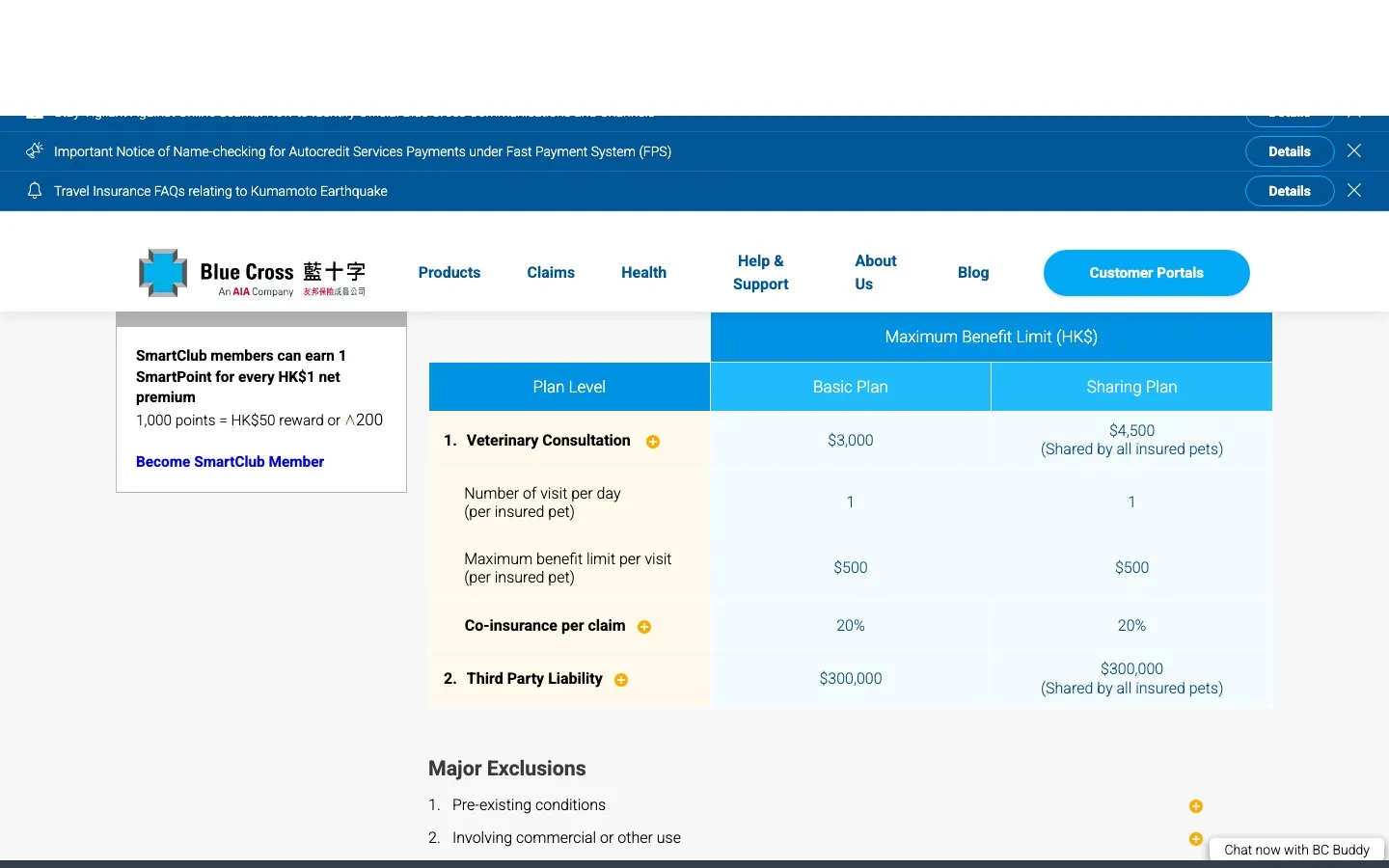
Blue Cross LovePet Outpatient Insurance is a small, specific budgeting tool: it reimburses part of eligible consultation-related spending, but the live benefit table checked on 11 August 2026 shows a HK$500 per-pet, per-visit cap and HK$3,000 Basic annual limit. It is not catastrophe cover. The Sharing Plan raises the policy pool to HK$4,500 for two or three enrolled pets, but that pool is shared. Both structures apply 20% co-insurance.
Best for: an eligible household that understands it is buying limited outpatient support, particularly a two- or three-pet household that can use the shared pool unevenly.
Skip it if: the main concern is a five-figure operation, prolonged admission, cancer treatment or chronic medicine. Compare comprehensive plans in our Hong Kong pet-insurance guide.
DogDogHK reviewed Blue Cross’s public product documents on 11 August 2026; no compensation was received. This is general information, and the issued policy wording and schedule govern cover.
What exactly is the product?
LovePet Outpatient is a Hong Kong general-insurance product underwritten by Blue Cross (Asia-Pacific) Insurance Limited, which its product page identifies as a Hong Kong authorised insurer. It is separate from Blue Cross’s broader LovePet Insurance. The similar name is the first trap: buying “LovePet” does not tell you which benefit schedule you hold.
The outpatient policy has two choices. Basic covers one pet with an annual veterinary-consultation limit of HK$3,000. Sharing is available only when the same policyholder enrols two or three pets; its HK$4,500 annual consultation limit and HK$300,000 liability limit are shared across them. There is no published universal premium worth repeating here because age band, pet count, tax/levy and current promotions can change the quote.
What the outpatient benefit includes
The official benefit page lists expenses incurred at a licensed veterinary clinic for illness or injury: veterinary consultation, prescribed drugs, dressings, injections, X-rays, ultrasound and laboratory tests. The schedule permits one visit per day per insured pet and currently caps the benefit at HK$500 per visit per pet. A 20% co-insurance also applies per claim. Save the dated benefit table supplied with a quote, because online pages and downloadable marketing documents can be revised on different schedules.
Do not read the list as unlimited diagnostic cover. The per-visit and annual limits still control the payout, and the policy definition of an eligible expense controls before percentages are applied. Surgery, a hospital catastrophe and ongoing treatment can quickly extend beyond this deliberately small pool.
Both plans also list HK$300,000 third-party liability. The first HK$3,000 of every liability claim is the policyholder’s excess. In the Sharing Plan that liability limit is shared. Liability normally responds only where the insured is legally liable for covered accidental injury or property damage; it is not a fund for every noise complaint, fright or neighbour dispute.
Waiting period, eligibility and exclusions
Illness-related medical claims have a 30-day waiting period from the effective date. The application materials ask health and behaviour questions, including recent treatment, previous surgery, physical defect and aggression history. Answer the exact questions fully and retain the submitted application. A symptom during the waiting period can matter even if a diagnosis is made later.
The terms exclude pre-existing conditions and routine or preventive spending. Vaccination, desexing, parasite prevention, grooming and ordinary dental maintenance should not be assumed covered merely because a vet performs them. The contract, not the checkout summary, decides. Ask for the specimen terms if they are not visible during application.
How a claim may work in practice
Consider an eligible HK$1,000 visit. Applying 20% co-insurance would produce HK$800, but the published HK$500 visit ceiling means the maximum benefit is HK$500; the owner retains at least HK$500. On a HK$2,500 eligible visit, the same ceiling leaves at least HK$2,000 with the owner. Then track how much of the HK$3,000 or shared HK$4,500 annual pool remains.
For three HK$1,500 eligible visits in a year, the current visit ceiling limits the total benefit to at most HK$1,500 before any other policy restriction. A Sharing household should also decide what happens if one pet consumes most of the common pool before another becomes ill. Shared cover offers flexibility, not three separate HK$4,500 limits.
Blue Cross provides a pet-claim route among its general-insurance claims services. Expect to keep the completed claim form, itemised clinic invoice, receipt, clinical notes and requested supporting documents. Pay-first-and-claim-later should be your assumption unless the current contract expressly offers direct settlement. Never postpone urgent treatment waiting for paperwork.
Strengths
- The schedule is understandable: per-visit limit, annual limit and 20% co-insurance are visible.
- Sharing can suit households whose pets’ outpatient needs do not occur evenly.
- Tests and prescribed medicines can qualify when they form part of an eligible visit.
- Third-party liability is included rather than sold as the medical benefit alone.
Watch-outs
- HK$3,000 or HK$4,500 can be exhausted by a short diagnostic work-up.
- Sharing limits belong to the policy, not separately to every pet.
- The product does not become comprehensive simply because X-ray and ultrasound appear in the list.
- A 30-day illness wait and pre-existing-condition assessment can affect later claims.
- Marketing rewards and first-year promotions are not reasons to choose the policy.
The Consumer Council’s July 2026 review of 24 pet plans found premiums ranging from roughly HK$1,000 to HK$14,000 and showed that higher premiums did not reliably mean lower out-of-pocket cost. Its scenario work is especially relevant here: visit caps, frequency and annual limits can produce very different results for one visit versus five.
Who it fits—and who should self-fund instead
LovePet Outpatient can fit an owner who wants a defined reimbursement contribution and values liability cover, while keeping a separate emergency fund for surgery. It can also fit a multi-pet home prepared to manage a shared pot.
It is a weak fit for someone who says “I want insurance so I can approve emergency surgery without worrying about the deposit.” For that goal, model comprehensive medical cover and savings. It may also be poor value if you can comfortably set aside the premium and accept outpatient volatility yourself. That is a household decision, not a universal verdict.
Application checklist
- Confirm you selected LovePet Outpatient, not comprehensive LovePet.
- Download the dated leaflet, terms, quote and submitted answers.
- Verify every pet’s entry and renewal age on the live application.
- Disclose symptoms, tests, medication, surgery and behavioural history accurately.
- Mark the 30-day illness wait, current HK$500 visit cap and annual pool.
- Ask how the clinic must itemise consultation, drugs and tests.
- Keep savings for excluded cost, co-insurance and payment upfront.
Red flags
- Anyone describes the plan as “full medical cover.”
- A seller calculates 80% of every invoice without applying the per-visit limit.
- The shared limit is presented as applying separately to two or three pets.
- You are encouraged to omit an old symptom because “there was no diagnosis.”
- No one will provide the policy wording before payment.
Editorial verdict
LovePet Outpatient is honest in its name and useful only when bought with the same narrow expectation. The Sharing Plan is the more distinctive design, but the small pool requires discipline. We would shortlist it for outpatient smoothing plus liability—not for transferring the financial risk of major veterinary treatment.
FAQ
Does it cover surgery?
Do not treat it as surgical insurance. The published outpatient schedule centres on eligible consultation, prescribed items and named diagnostics within low visit and annual limits.
Is the Sharing Plan HK$4,500 per pet?
No. The leaflet says the limit is shared by all insured pets under that plan.
Can I claim during the first month?
The leaflet applies a 30-day wait to medical expenses resulting from illness. Accident and other exact timing must be checked in the current terms.
Is reimbursement cashless?
Do not assume so. Budget to pay the clinic and submit a claim unless the current policy and clinic confirm direct settlement in writing.
Who regulates the insurer?
Blue Cross identifies itself as a Hong Kong authorised insurer. Confirm the legal name in the Insurance Authority’s current register.