SPCA Hong Kong dog training review: courses, fees and who they suit
Independent research review of SPCA Hong Kong dog training, including 2026 course fees, venues, enrolment, positive-reinforcement method and suitability.
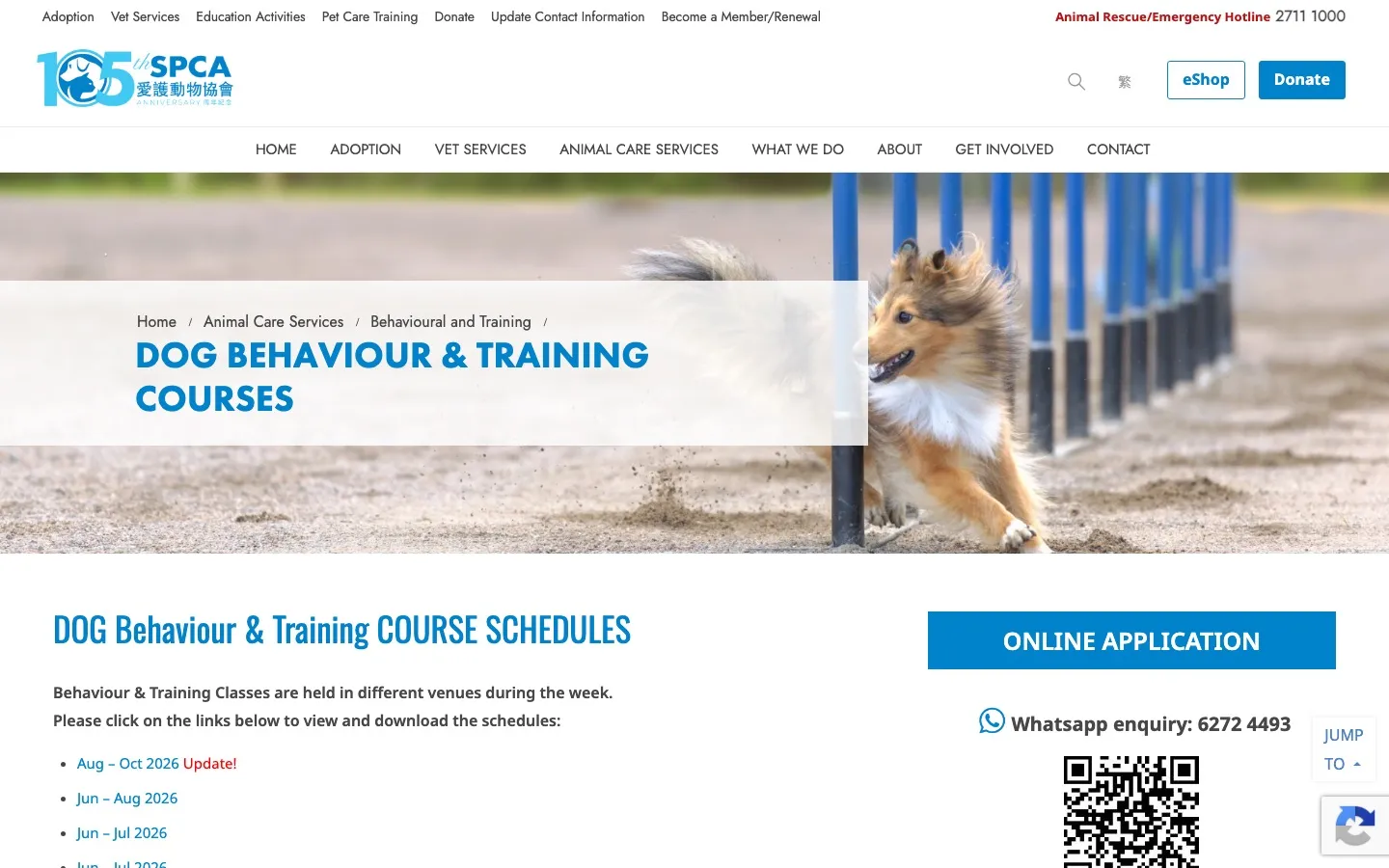
Quick verdict
SPCA Hong Kong is the easiest mainstream training service to compare before paying. It publishes live schedules, language, venue, dog-size or age criteria, fees and a clear application step requiring vaccination records. Its stated method is positive reinforcement, and the course menu ranges from puppy socialisation and basic obedience to scent games, clicker work, agility, etiquette and a separate behaviour course.
Our strongest recommendation is for owners wanting structured group foundations at a known Wan Chai or Tsing Yi venue. The limitation is equally important: a scheduled group class is not a substitute for individual risk assessment when a dog is severely fearful, reactive or has bitten. SPCA does advertise private classes and behavioural support, but owners must enquire for case-specific format and price.
Compare it with private and home-based options in our Hong Kong dog-training services review.
Scope, checked date and disclosure
DogDogHK reviewed SPCA Hong Kong’s public Behaviour & Training and booking pages on 11 August 2026; no compensation was received. Course descriptions and methods are SPCA’s published claims, while the verdict is our editorial assessment. The live intake page carries current timetables, instructors, fees and places.
Our welfare baseline is reward-based learning. The American Veterinary Society of Animal Behavior position statements recommend reward-based methods rather than aversive tools or physical/psychological punishment. SPCA itself says it uses positive reinforcement to motivate the dog and build trust rather than fear.
Training cannot diagnose pain or illness. Sudden aggression, touch sensitivity, house-soiling, disorientation or abrupt behaviour change should start with a Hong Kong registered veterinary surgeon.
Organisation and service background
SPCA Hong Kong is an animal-welfare charity with veterinary, adoption, education and pet-care services as well as dog behaviour and training. That institutional breadth is useful: the public site separates general courses, behavioural consultation and veterinary care rather than presenting every concern as an obedience problem. It does not mean every dog automatically fits a class; pre-screening remains essential.
Group courses are listed at:
- Hong Kong Centre: 2/F Terrace, 5 Wan Shing Street, Wan Chai.
- Tsing Yi Centre: 38 Cheung Fai Road, Tsing Yi.
Classes are normally weekly unless the schedule says otherwise. SPCA says the first lesson is generally a human-only theory class; the Dog Walking Manner Course is an exception. That orientation is a strength because owners can learn management and reinforcement mechanics before bringing dogs together.
Courses and formats
The live menu includes puppy socialisation, small- and large-dog basic obedience, fun scent games, clicker training, behaviour training, beginner agility, workshops, etiquette and private lessons by appointment. Current puppy socialisation is for puppies under 18 weeks before the course begins. Basic obedience separates dogs under and over 10 kg, which may make the physical environment more manageable but is not a temperament assessment.
The distinction between formats matters:
- Puppy socialisation should teach safe, gradual exposure and owner skills, not unstructured free-for-all play.
- Basic obedience suits well-socialised adolescent/adult dogs learning foundation behaviour around manageable distractions.
- Scent, clicker and agility are enrichment or skill-building, not treatment for pain, panic or aggression.
- Dog Behaviour Training Course/private support may be a better entry for individual problems, subject to SPCA screening.
Ask exactly who teaches your intake, the trainer-to-dog ratio, whether family members may attend, and what happens if a dog cannot cope in the room.
Published fees checked 11 August 2026
SPCA’s general fee table listed puppy socialisation and basic obedience at HK$2,000 for an SPCA-adopted dog’s first eligible course, HK$2,200 for members, and HK$2,600 for non-members. The adopted-dog rate requires registration within three months of adoption and applies to the first course. A second dog in the same class receives a published HK$200 discount.
Fun Scent Games was listed at HK$2,500 for members and HK$3,000 for non-members. A live October 2026 Dog Behaviour Training Course showed HK$1,700 member/HK$2,100 non-member. Prices are per dog and intake-specific; check the actual enrolment row. Membership is not required to join, although member pricing applies where shown.
The page links separately to payment and policy details. Before paying, verify refund, transfer, missed-class and weather arrangements, especially during Hong Kong typhoon or black-rain warnings. Do not assume a place is held until SPCA confirms acceptance and payment.
Application and intake
SPCA instructs applicants to complete its online form and upload the dog’s vaccination record. Places are limited and first-come, first-served; successful applicants are notified before payment. The public page lists WhatsApp 6272 4493, phone 2232 5567 and email bt@spca.org.hk for training enquiries.
The vaccination step is useful but not enough for behaviour safety. In the application or an email, disclose barking/lunging, freezing, escape attempts, guarding, bites (including context and injury), pain, medication and ability to settle near dogs and strangers. Ask staff to recommend the correct format rather than selecting the most convenient time slot first.
Training method and credentials
SPCA’s official method statement is specific at the high level: positive reinforcement, motivation and reward, with a trust-not-fear rationale. That aligns with a humane baseline. Still ask operational questions: What happens when the dog cannot take food? Are choke, prong or electronic collars prohibited? How is distance increased for a worried dog? Can the dog leave early without being flooded?
The organisation describes its trainers as professional, but a course page is not a credential register for every instructor. If an independent certification matters to you, ask who will teach and what current education or credential they hold. A dog-training certificate is not veterinary registration and does not permit diagnosis or prescribing.
Practical Hong Kong fit
Wan Chai and Tsing Yi give owners on both sides of the harbour a fixed-site choice, but transport can decide whether the programme is humane. Rehearse the route. Consider lift lobbies, taxi/carrier rules, heat, toilet breaks and how your dog reacts after travel. Arriving already over threshold undermines learning.
English, Chinese or bilingual delivery varies by intake; the live schedule labels each class. Confirm that the principal handler understands the teaching language well enough to apply timing and safety instructions. A theory-first week is particularly helpful for multi-person families: decide who uses cues, rewards and management consistently at home.
Strengths
- Live schedule with venue, language, date and fee.
- Explicit positive-reinforcement position.
- Human-only theory start for most courses.
- Multiple foundation and enrichment formats.
- Vaccination record required at application.
- Member, non-member and eligible adopted-dog fees are clearly separated.
Watch-outs
- Group classes are unsuitable for some fear, aggression and bite-risk cases.
- Weight grouping does not guarantee compatible temperament.
- Current private-class prices and exact arrangements require enquiry.
- Fixed weekly dates may be difficult for shift workers; missed-class policy matters.
- Published organisational method should still be confirmed with the actual instructor.
Best for — and who should skip
Best for: young puppies within the age window; sociable dogs needing foundation manners; owners who want a syllabus and can practise weekly; families who value transparent fees and a fixed venue.
Skip the group-first route: dogs that cannot safely be near unfamiliar dogs/people; recent serious bites; severe separation panic; pain-linked behaviour; or animals too distressed by the journey. Ask about private behavioural support and veterinary input instead. Dogs with respiratory or orthopaedic limitations need veterinary clearance before agility or strenuous work.
How to book and prepare
- Read the live schedule and course eligibility, not an old social post.
- Describe goals as observable situations: “barks in the lift at 3 metres,” not “is naughty”.
- Disclose medical and bite history and ask whether group class is suitable.
- Upload the current vaccination record and wait for acceptance before paying.
- Confirm language, class size, equipment rules, weather, refund and make-up policies.
- Practise the route at a quiet time; bring the recommended harness/lead, high-value food, water and waste bags.
- Keep the dog below threshold. Tell the instructor early if it cannot eat, settle or create distance.
- Schedule short home practice between lessons; progress comes mainly from consistent repetition.
Welfare red flags in any class
Leave or pause if an instructor recommends alpha rolls, physical intimidation, deliberate flooding, leash jerks, choke/prong/electronic collars, or forcing greetings after the dog tries to escape. Also reject guaranteed cures and advice to withhold veterinary care. A humane trainer changes distance, environment and task difficulty; “obedience” does not justify overriding fear or pain.
Editorial verdict
SPCA is our clearest recommendation for an owner who wants a transparent, structured Hong Kong group-course starting point. Published fees and intake details reduce uncertainty, while the positive-reinforcement statement provides a defensible welfare baseline. The service is strongest when owners choose by dog suitability, not calendar convenience. For riskier or medically complicated behaviour, use SPCA’s consultation route or another qualified private professional in coordination with a registered vet.
FAQ
Must I be an SPCA member?
No. The page says non-members may enrol, with different published fees.
Does my dog attend the first lesson?
SPCA says the first lesson is normally theory without the dog, except the Dog Walking Manner Course. Verify your intake.
Are puppy and obedience courses five lessons?
Current schedule examples show one theory class plus four dog-attendance classes, but formats may change. Read the exact dates.
Can a reactive dog join basic obedience?
Do not assume so. Disclose triggers and incidents before payment and let staff screen for group, behaviour course or private support.